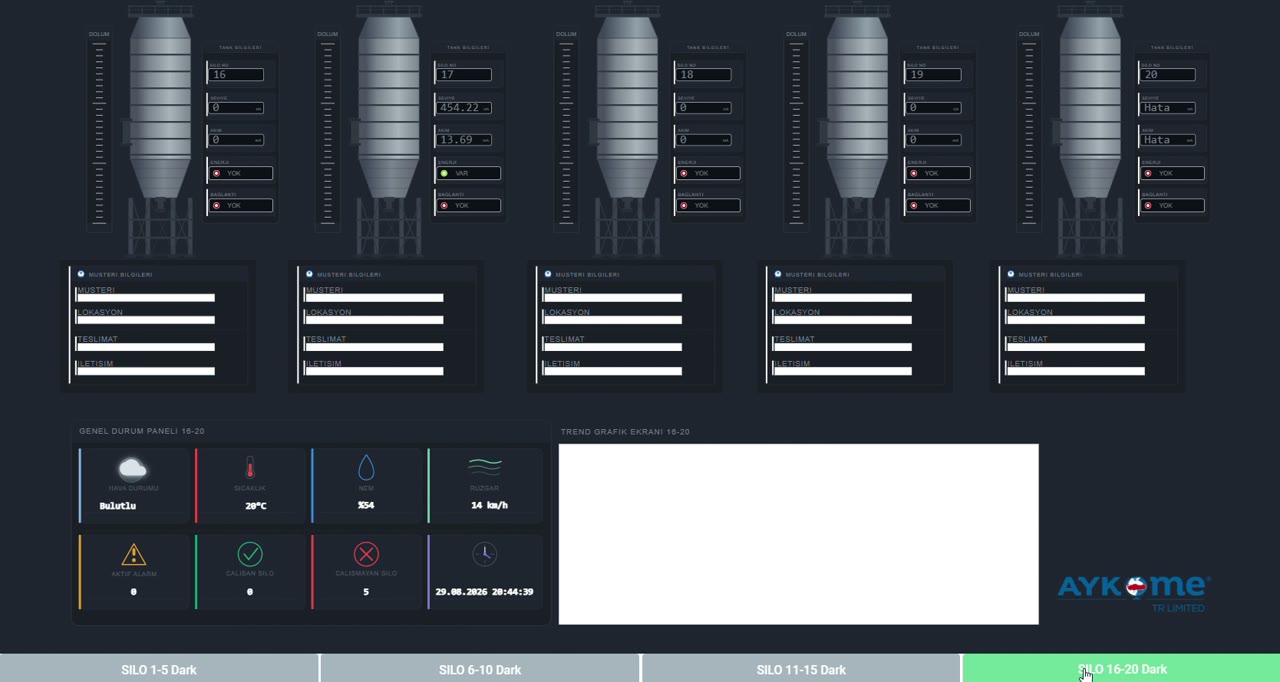
For a plaster manufacturer, the most critical logistics question is a single sentence: which customer's silo will run out and when? When this question goes unanswered, one of two scenarios becomes inevitable. Either a needless trip is made before the silo is empty and transport cost is wasted; or the silo empties completely, the customer's site stops, and an un-billable loss of reputation follows.
All Alçı decided to manage this question with data rather than by phone and guesswork. The system we built for the Gölbaşı plant as Aykome Engineering brought together the fill level, location, power and filling safety of 20 silos spread across different cities and sites in a single centre. What emerged is more than a monitoring screen: a digital twin of the entire field.
3D monitoring – seeing the field on screen
The most striking aspect of the project was that the silos are presented not as flat bar charts but with three-dimensional (3D) visualization.
- Each silo was modelled on screen in its real field form.
- The fill level rises and falls volumetrically inside the silo; the operator does not interpret a number but sees the fill directly.
- Colour codes were applied onto the 3D model; a silo approaching a critical level stands out instantly, wherever it is on the screen.
3D monitoring does not merely make the system "nice"; it shortens comprehension time. An operator taking over the screen at a shift change grasps the state of the field within seconds, without reading a table. Even a manager who has never seen the field understands at a glance which silo is critical.
Silo-tanker safety system – overflow is stopped by the system, not the screen
The most expensive mistake in silo filling is overfilling: overflowing product, a contaminated site, an operator in danger and wasted material. In the classic approach, this risk is managed only by the silo-tanker operator's attention and rule of thumb.
In this project, overfilling was taken out of the realm of a warning and turned into a physical safety layer:
- A defined filling level was set for each silo.
- When the silo reaches this level, the system engages and does not allow the silo-tanker (silobas) operator to load.
- Safety does not depend on the operator looking at the screen, noticing the warning or deciding at the right time; the system enforces the decision itself.
The result: product loss, site contamination and occupational-safety risk from overflow are eliminated at the source. This is the topic that turns the project from a monitoring application into a protection system.
Silo card: not just level, but the whole job
Each silo was designed not as a level indicator but as a complete operational record. Each silo card includes:
- Instant fill level (cm and %)
- The silo's location in the field — which city, which site, which point
- Customer / company name
- Contact person and phone number
- Address and site information
- Last delivery information
- Power on / off status and communication health
The dispatch officer who sees a low-level silo on screen does not consult a separate list, an Excel file or an employee's memory: they see who to call, where to send a run, and when the last delivery was made on the same card. Institutional memory has moved from people to the system.
Power on/off information – the difference between "no data" and "empty silo"
The most common mistake at remote sites is misreading the silence. The system monitors the power on/off information as a separate data point for each silo:
- A silo that loses power is marked with a distinct status on screen.
- A communication problem is distinguished from a power outage.
- So the team knows what the problem is before going to the field; no trip is wasted.
Multi-level alarm system and field warning
A three-level alarm structure that runs both digitally and physically was built for every silo in the field:
- Green: Level in the normal range, no action needed.
- Yellow: Approaching the critical level; delivery should be planned.
- Red + horn: Silo at the emptying limit; urgent intervention needed.
The warnings do not stay only on the central screen; they also run as a physical lamp and horn on the silo panel in the field. The operator at the customer site sees the situation with their own eyes without calling the centre. Critical situations are also reported automatically to the relevant teams.
Reporting – taking delivery out of guesswork
Beyond showing the instant state, the system makes the field measurable:
- Silo-based consumption reports: How fast each customer consumes is revealed with historical data.
- Delivery history: When and how often each silo was supplied is recorded.
- Periodic comparison: The delivery plan can be set in advance over daily and monthly trends.
- Site-health reports: Where communication and power outages concentrate can be seen.
Thanks to the reports, delivery moves from the "run to the calling customer" reflex to a planned operation.
Screen architecture and operator experience
Rather than being crammed onto a single crowded page, the 20 silos were split into four main screens in groups of five: Silos 1‑5, 6‑10, 11‑15 and 16‑20. The dark-theme choice was set to reduce eye strain for the operator looking at the screen throughout the shift.
The screens also show live weather, temperature, humidity and wind information along with time/date; when planning delivery, road and field conditions can be assessed from the same screen. Field lighting, meanwhile, is controlled automatically according to Ankara's sunrise and sunset times.