The social facility of a residential complex is a place of leisure for residents; for the complex management, however, it is a small business that must be managed every day — from pool chemistry to energy consumption, from pump life to user safety. Pool circulation stopping early, a water-park motor running for nothing, a sauna continuing to heat at full power when no one is present, or landscape lighting burning during the day; none of these counts as a fault, yet all of them are cost.
The automation system we developed for Natura Batıkent as Aykome Engineering brings all the mechanical and electrical systems of the social facility together on a single control screen. The equipment can be managed both with automatic scenarios and, when needed, by the operator's hand.
Outdoor and indoor pool systems
The outdoor pool and indoor pool systems at the facility are monitored and controlled on a single screen together with their circulation equipment:
- Circulation pumps: The pumps' running status, fault information and operating times are tracked in real time.
- Automatic and manual operation: Automatic or manual mode can be selected from the screen for each pump. While routine operation runs on automatic scenarios, control passes to the operator with a single click during maintenance and cleaning.
- Automatic run-time equalization: Pumps doing the same job are brought online in turn so their operating hours are balanced. A single pump carrying the load and wearing out early is prevented, maintenance intervals are distributed evenly across all equipment, and redundancy is preserved.
- Schedule times: Pool circulation can be scheduled according to the facility's usage hours; the times are updated from the screen at seasonal changes.
Water-park slide motors
The slide motors on the water-park side were included in the system with the same logic:
- The motors' running and fault status is monitored in real time.
- Automatic and manual start‑stop control can be done from the screen.
- Thanks to automatic run-time equalization, the motors run alternately; no motor wears more than the others.
- Motors running for nothing outside usage hours are prevented.
This structure noticeably reduces both energy consumption and the risk of a fault during the season.
Landscape lighting by sunrise and sunset
The complex's landscape lighting runs not by fixed times, but by the real sunrise and sunset times of the complex's location in Ankara.
- The lighting switches on automatically at sunset and switches off automatically at sunrise.
- These times update automatically every day. No manual intervention or time-relay setting is required at seasonal transitions.
- If needed, the operator can also set the times manually; the system keeps its flexibility for special events, maintenance or unusual situations.
The result: no lamps left burning after daybreak, and no landscape lighting still unlit after darkness falls.
Turkish bath and sauna – smart heating triggered by a user hand-read
The part of the project that made the biggest difference was integrating the Turkish bath and sauna systems into the hand-reader buttons. Such systems are traditionally either left on all day and waste energy, or require calling an attendant for each use. The scenario we built eliminates this dilemma:
- When the user has their hand read: The system engages and the Turkish bath/sauna rises automatically to the temperature level pre-defined by the operator.
- After the user leaves: The system does not shut down completely; it goes into standby mode. Thus the next user gets a fast response while full-power operation while idle is eliminated.
- At the end of the day: After the closing time set by the operator, the system takes no start or stop command. Accidental or unauthorized use outside working hours becomes impossible.
The temperature levels and the closing time were not hard-coded into the software; both can be defined by the operator from the screen.
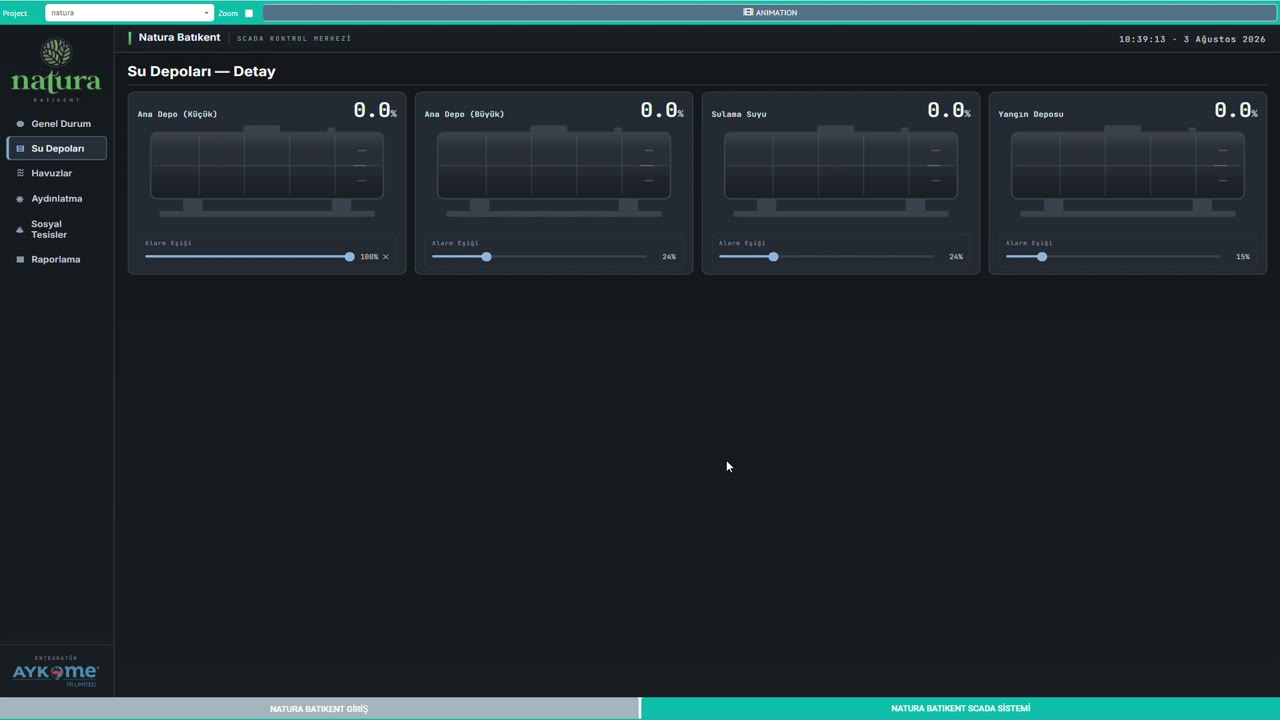
Level monitoring of fire and reserve water tanks
One of the most critical topics for site safety is the tanks that must be full at the moment of need. Within the system:
- The instant fill level of the fire-water tanks is continuously monitored as a %.
- The level of the reserve water tanks is likewise tracked on a percentage basis.
- Level drops can be seen before the moment of need arrives, and generate an alarm.
Whether a fire-water tank is full no longer relies on periodic checks or assumption, but on the instant value on screen.
Operator experience and access
All systems were gathered onto a single control screen. Technical staff from within the facility and the complex manager from their office or mobile device can access the same information; no separate program installation is required.
For each piece of equipment, the automatic/manual selection, schedule times and threshold values can be changed by the operator from the screen. The system was designed not as a structure that constrains the operation, but as one that applies the operation's decisions.